Free · Kazakhstan
Read the Station, Not Just the City, on Your Kazakhstan Train Ticket
Kazakhstan Ready — practical travel / Free article
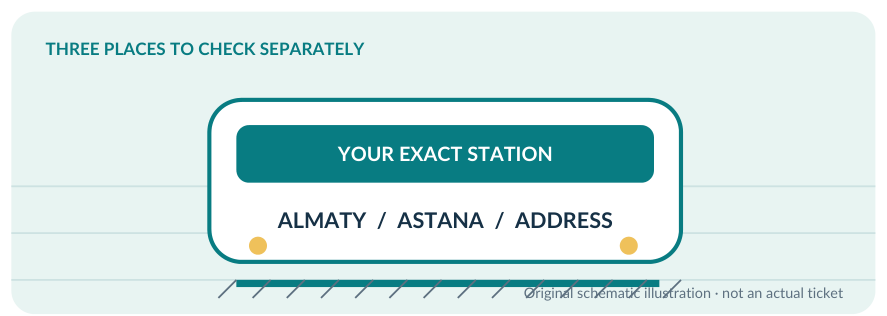
A search for a train from Almaty to Astana may feel like a complete journey plan. You have two city names, a date, and perhaps a seat. But those details are not enough to tell a driver where to take you, or to tell you where you will actually step off the train.
The question to answer before you pay—and again before you leave—is: which railway station is named for my particular train and date? The official Kazakhstan railway ticket site searches broadly by city, while its results and the ticket identify more specific places. Railway notices can also change where passengers may board or get off.
This free guide shows how to separate the city, the actual station, and the final address. It covers one realistic situation—travel between Almaty and Astana—without assuming that every train uses the same terminal or that an old online itinerary is current. You will be able to perform the station check yourself without purchasing a larger guide.
1. Three names, three different jobs
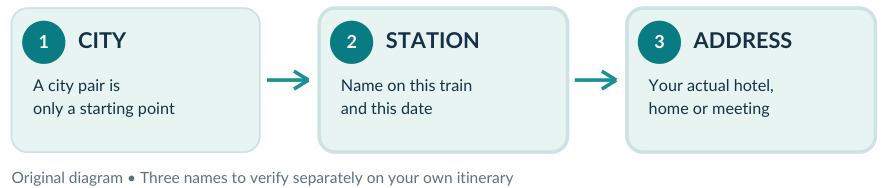
Think of the trip as three layers:
| Layer | What it tells you | The question to answer |
|---|---|---|
| City | The broad place you want to travel between, such as Almaty or Astana. | Am I searching the right cities? |
| Railway station | The specific place associated with a train's boarding or arrival stop. | Which named station does this particular train use on this date? |
| Street address | Your hotel, home, office or other final destination. | What connects the arrival station to the actual door? |
Do not treat the second and third layers as interchangeable. A station in the right city may still require another journey with luggage. Likewise, a city name on a search result is not permission to board at any station within that city.
The official ticketing website, bilet.railways.kz, shows Almaty and Astana as city-level search choices and then shows train-specific routes, times and carriage options in its results. It also maintains separate notices about station operation and temporary ticket-sale restrictions. [1][2][3]
A useful habit: whenever you read a train result, copy the station wording exactly as displayed—including the number or special name—before you open a map.
2. Almaty and Astana are not each one undifferentiated station
In railway materials you may see names such as Almaty-1, Almaty-2, Astana-1, and Nurly Zhol. In official Cyrillic material you may encounter forms such as Алматы-2 and НҰРЛЫ ЖОЛ. Station-number formatting and transliteration may vary by interface; copy the exact wording from your own current booking rather than treating similarly named stations as interchangeable. [1][4]
A ticket seller's summary may say only “Almaty → Astana,” while the train details specify where that service stops. Open the train details and the document for your exact journey. Do not decide a station from the city name alone.
This is especially important when a third-party travel page gives a station name but the railway operator has announced a temporary change. Both the station and its passenger-boarding status matter.
A real 2026 example of why this matters
In a notice published on 22 July 2026, Kazakhstan's official railway ticketing site confirmed that passenger boarding and alighting at Almaty-1 had been temporarily suspended since 15 July 2026 due to station reconstruction. The notice distinguished trains passing through without a stop from trains making a technical stop, in both cases without passenger boarding or alighting at that station. [2]
That is a warning about how to read an itinerary, not a claim that the same disruption will remain in force indefinitely. On the day you intend to travel, you must check the current official notice and your actual train. A train passing a station—or making a technical stop there—does not automatically mean passengers can get on or off.
Practical response if your source still says Almaty-1: do not go there expecting to board merely because an older article or a search label mentions it. Verify the current permitted boarding point for your train with the operator. The published help centre lists the short information number 1433; see the official contact page for any international-calling or other options that apply to you. [5]
Another official notice, dated 28 August 2026, announced a temporary halt to advance ticket sales for certain services, including train 4/3 on the Nurly Zhol–Almaty-2 route from the specified October dates, pending a subsequent resumption announcement. A pause in advance sales is not by itself the same claim as cancellation of every journey. Since such restrictions can change, check the current official ticketing result and later notices for your own train and travel date, rather than relying on an old timetable. [3]
3. One fictional booking, seven things to read
Imagine that Maya has booked an overnight rail journey between the two cities. She needs to reach an appointment in Astana the next morning, with a suitcase. Below is a fictional training record, not a valid ticket. The fields are illustrative; it intentionally has no train number, barcode, QR code, personal document number, price or live departure time.
ILLUSTRATION — NOT A TICKET
Search: ALMATY → ASTANA
Train and date: to be verified in the current operator result
Boarding station: ALMATY-2 [example only]
Arrival station: NURLY ZHOL [example only]
Passenger identity: match against the travel document actually used
Carriage / place: read the assigned values on the real booking
Final destination: hotel or appointment street address, checked separately
The two station names are familiar from official materials, but their pairing here does not assert that a particular train is running or selling places. [1][3] Maya's actual train may use a different station, may not be available that day, or may have revised instructions.
Maya checks seven separate fields in her genuine booking before relying on it:
1 — Departure city and boarding station. The city establishes the broad direction. The station decides where her taxi or local connection must take her. She does not use a generic “Almaty railway station” map pin without confirming the exact station.
2 — Arrival city and station. “Astana” is a destination city, not the address of Maya's hotel. She records the specific named arrival station before looking up her last connection.
3 — Travel date and departure time. She reads the actual operator result or issued ticket, not a time copied from a blog. For an overnight journey, she checks the date beside each departure and arrival rather than assuming they fall on the same calendar day.
4 — Train or service identification. The train number or other exact service identifier allows her to check the right notices and seek help. She does not infer its availability from a similar route name.
5 — Passenger identity and travel document. The operator's boarding guidance says passengers should present the ticket and the identity document whose number was provided at purchase. Maya checks the actual document type and number used, and brings that document. If a seller or booking screen differs, she asks the operator to resolve the mismatch before travel. [6]
6 — Carriage and seat or berth. She identifies what the actual issued booking assigns. A seat category advertised in a search filter is not proof she has obtained that particular carriage or place.
7 — Issuance and current ticket status. She finds the booking through the channel that issued it. The official KTZ site offers a ticket-status lookup and a boarding-pass or ticket-copy service. These tools are not a substitute for checking whether a named station is currently accepting passengers. [7][8]
Maya only then compares a transfer to the arrival station with a transfer to her actual address. If she expects a late arrival or has accessibility requirements, she contacts the relevant operator or accommodation provider rather than assuming a bus, taxi stand or station facility will be available.
4. A reliable station-check sequence, from search to station entrance
You do not need to know the whole railway network. You need to follow one journey carefully.
Before buying
A. Search through the operator's official sales portal. Begin with the intended cities and date at bilet.railways.kz. If you use a commercial reseller, compare its exact station wording and conditions with the operator's current result. [1]
B. Open the specific train, not just the city-pair listing. Write down the complete origin station and destination station names visible for the segment you would purchase. If a result is unclear, seek clarification before paying.
C. Check relevant operator notices. The Almaty-1 reconstruction notice and the October 2026 advance-sales notice demonstrate that operational details do change. Use the operator's latest notices for your own date; do not substitute a departure date from a travel blog or a screenshot of last year's timetable. [2][3]
D. Compare the station with the rest of your travel day. How will you reach the exact departure station from your hotel, especially with luggage? How will you leave the exact arrival station? A cheaper or earlier train may not be more convenient if its real station connections are difficult.
After buying, before leaving your accommodation
E. Open the issued ticket and check every field again. Compare passenger names and travel-document details with the document you will show at boarding. Check current status and any service notices. [6][7]
F. Save a usable offline record. Keep the legitimate ticket or boarding instructions accessible without a data connection, together with the exact station names, your destination address and a transport backup. Confirm with the seller or operator whether any printout or other ticket presentation is required for the particular booking; do not infer that a screenshot alone will always suffice.
G. Recheck the station's passenger-boarding status. If your itinerary references Almaty-1—or another station affected by a special notice—do not infer that a technical stop is also a boarding opportunity. Confirm with the operator using your exact travel date and train. [2]
At the station
H. Match the station entrance and train details. Use official boards and instructions. If there are differing train and platform displays, ask station staff rather than guessing from a timetable copied online.
I. Have the ticket and original travel document ready. The carrier's own boarding guidance links the document presented to the details supplied during purchase. Avoid showing identity information to unsolicited helpers or posting photos of your ticket and document publicly. [6]
J. Keep your arrival connection independent of the rail ticket. Your train reservation is not a promise that a local transfer, hotel pickup or taxi will be waiting. Reconfirm that arrangement, especially after delays or changes.
5. Three situations where a small mistake becomes a big detour
Situation A — “The map says Almaty-1, but the operator notice says boarding is suspended”
A traveler reads an older page recommending a station and finds the same name on a general railway map. That is not enough evidence to board there. The operator's July 2026 notice explicitly separated technical stops and passing trains from passenger boarding. The right next step is to check the active notice and the traveler’s specific service, then verify the permitted boarding station with the operator. [2]
Do not improvise by going to the next named station on the route. A seat on a particular journey is not an open invitation to board at any stop.
Situation B — “The route is right, but the booking site says the train is not for sale”
A traveler sees an old timetable with an appealing departure. The operator's August 2026 notice names several trains whose advance ticket sales were temporarily halted from designated October dates. That notice is not definitive evidence about every later service, but it means an old timetable cannot establish today's ticket availability. [3]
The traveler should check a current official result, consider a different verified service or date only if genuinely available, and contact the official help centre for an unclear discrepancy. Do not pay an unofficial person who promises to override a booking restriction.
Situation C — “I reached Astana, but where is my hotel?”
A traveler saves “Astana station” in a phone map without noting the station on the ticket. On arrival they discover the hotel is still another journey away. The problem was not necessarily the train: the last part of the itinerary was left undefined.
The better plan records the exact arrival station and hotel address in separate lines, confirms the onward connection for the arrival date and time, and keeps a backup for heavy luggage or limited mobility. A more expensive but simpler last leg may be sensible for that person's actual circumstances.
6. What to do if the ticket and live information disagree
A mismatch does not automatically mean your ticket is invalid, nor that the online source you consulted is wrong. It means the discrepancy needs an authoritative answer before you travel.
- Station mismatch: Give the official help channel the date, train/service identifier, station name on the ticket, and the text of the current notice. Ask specifically where passengers may board and alight for this service on this date.
- Unclear ticket status: Use the original booking channel and, when applicable, the operator's ticket-status lookup. Do not purchase a duplicate ticket just because the status screen needs clarification. [7]
- Passenger detail mismatch: Check with the issuing service and carrier how corrections are handled. Do not alter an image of the ticket or assume the guard will accept a different document number. [6]
- Connection disruption: Notify your accommodation or host about the changed arrival. Update the last-mile route based on the actual arrival station, not on the station you originally expected.
Official railway help and ticket services are listed on the carrier's site. Its current help page identifies 1433 for general enquiries and bilet@railways.kz for electronic-ticket questions. If calling from outside Kazakhstan, confirm the appropriate callable number or email; this article does not promise that the short number works internationally. [5]
7. The five-minute station card
Before departure, write the following somewhere you can open without internet access:
| Find this on the current source | Your own journey |
|---|---|
| Rail operator or seller, and where to retrieve the real ticket | __________________ |
| Departure date and train/service identifier | __________________ |
| Exact boarding station—not merely its city | __________________ |
| Current notice checked for that station and date | __________________ |
| Exact arrival station—not merely its city | __________________ |
| Passenger document used to book | __________________ |
| Carriage and seat/berth on issued ticket | __________________ |
| Street address of the destination after the train | __________________ |
| Last-mile connection and a practical backup | __________________ |
| Official help channel saved | __________________ |
If you cannot complete the boarding-station and arrival-station rows, your journey plan is unfinished. Check before leaving for the railway station, even if you already paid.
The main lesson is simple: the city gets you searching; the station gets you to the right train; the address gets you to the end of your actual journey.
Official-source notes and editorial evidence (retain with working source; not consumer copy)
- KTZ official ticketing home and search — https://bilet.railways.kz/ — city-level search choices, actual operator ticketing services and live news notices. Train-specific details should always be checked for the user's chosen journey.
- Official passenger boarding suspension at Almaty-1 — https://bilet.railways.kz/post/not111 — announced 22 July 2026, effective 15 July 2026; identifies multiple trains with no boarding or alighting there, including trains passing without stopping or making technical stops. Do not state that the suspension is permanent or that every train through Almaty-1 is described in this list.
- Official advance-sales suspension notice — https://bilet.railways.kz/post/sell-stop-1 — published 28 August 2026; covers named trains, including 4/3, effective from specified October 2026 departure dates, with future resumption to be announced. Do not equate suspended advance sales with entire-route cancellation. Check later announcements at publication.
- Operator website search results showing named station forms — https://bilet.railways.kz/sale/default/route/search?_locale=kz&route_search_form%5BarrivalStation%5D=2708001&route_search_form%5BdepartureStation%5D=2700000&route_search_form%5BforwardDepartureDate%5D=15-10-2026 . Historic date-specific query illustrates that train-specific stations are displayed; NOT a current or future seat/price/departure guarantee.
- KTZ official passenger help/contact — https://bilet.railways.kz/help?_locale=ru — general help 1433 and e-ticket support bilet@railways.kz as seen 22 Oct 2026. Do not represent 1433 as an internationally callable number.
- KTZ boarding and ticket inspection FAQ — https://bilet.railways.kz/help/category/6 — official guidance that passenger presents ticket and the identity document whose number was entered when buying; carrier's mobile checking device involved. No blanket statement that a screenshot always suffices.
- KTZ ticket status lookup — https://bilet.railways.kz/passenger/ticket/check/status — official ticket-number-based status check. We did not submit a ticket number.
- KTZ passenger boarding pass / ticket copy options — https://bilet.railways.kz/passenger/boarding-pass/ — services exist, but their operation was not transaction-tested.
Location references
These Google Maps searches identify the places discussed here. Confirm the exact address and current access separately.